
When Motivation Dies, Systems Keep You Alive
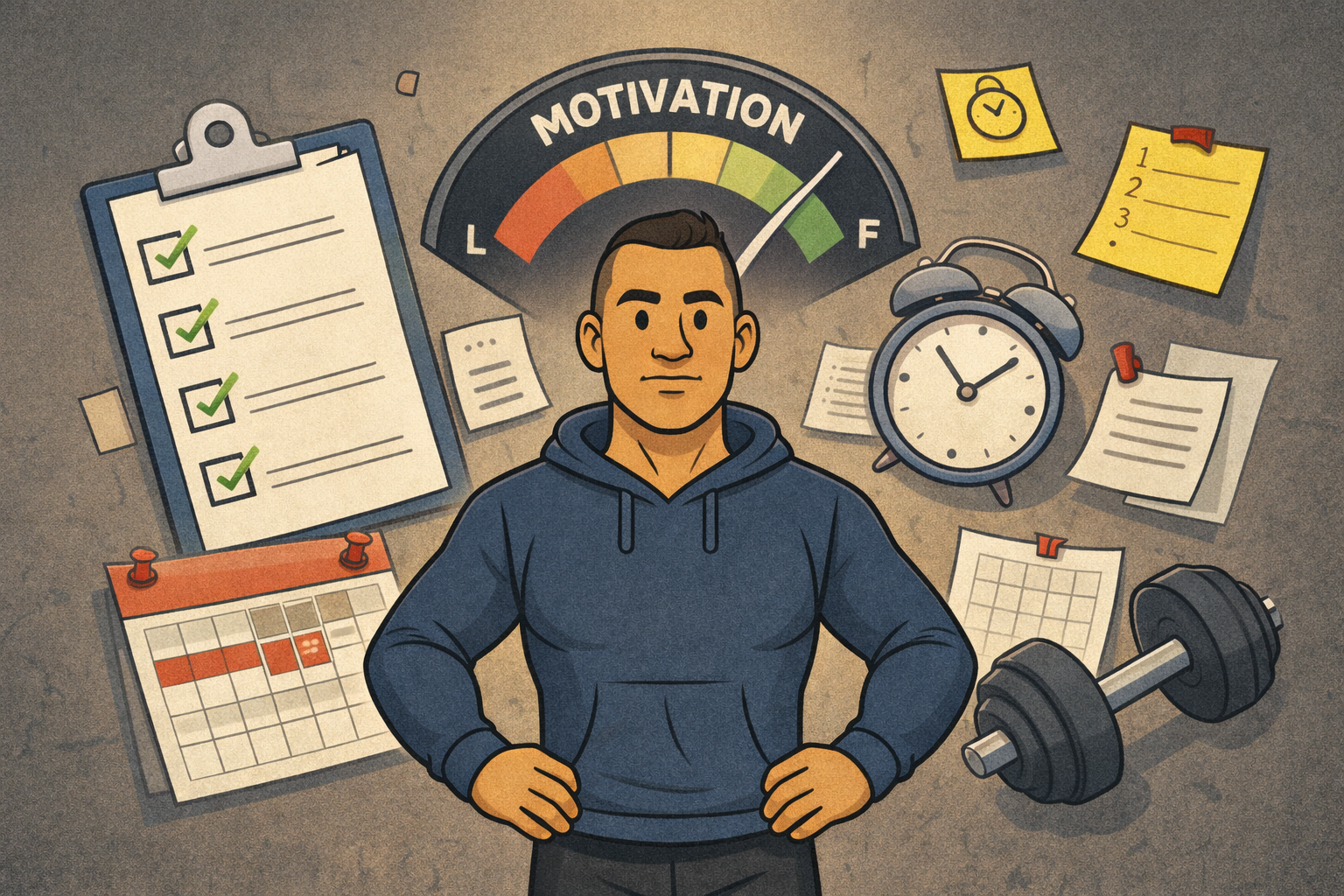
Why Discipline Isn’t About Willpower — It’s About Designing a Life That Carries You Through Dark Seasons
“Motivation is a feeling. Systems are what remain when feelings disappear.”
INTRODUCTION — THE DAY MOTIVATION FAILS
There will come a day — and for many, it’s sooner than they expect — when motivation disappears.
Not fades.
Not weakens.
Disappears.
That day doesn’t come because you’re lazy.
It comes because life applies pressure.
Grief.
Loss.
Financial stress.
Injury.
Divorce.
Fatigue.
Mental exhaustion.
Burnout.
Motivation was never designed to survive these moments.
Yet most people build their health around it anyway.
They wait until they feel like it.
They train when they’re inspired.
They eat well when things are calm.
They stay consistent when life cooperates.
And when life doesn’t?
Everything collapses.
A HARD PERSONAL REALIZATION
There were seasons in my life where motivation wasn’t just low — it was gone.
After watching my house burn down.
After losing my business.
After losing my marriage.
After losing my father.
After feeling my relationship with my children slip through my fingers.
After financial instability.
After caring for my elderly aunt.
After battling binge-eating episodes I didn’t talk about publicly.
In those moments, motivation was not available.
But something else was.
Systems.
Simple, unglamorous, repeatable systems carried me through when motivation couldn’t.
And they can do the same for you.
WHAT MOST PEOPLE DON’T UNDERSTAND ABOUT MOTIVATION
Motivation is chemically driven.
It relies heavily on dopamine — a neurotransmitter that responds to novelty, excitement, reward, and anticipation.
That’s why:
New programs feel exciting
New years feel powerful
New goals feel energizing
But dopamine is unstable under stress.
Did You Know?
Chronic stress suppresses dopamine signaling, making motivation biologically harder to access — even if you “want” to care.
This means that during the exact moments you need healthy behaviors most, your brain is least capable of producing the motivation to do them.
This is not a mindset issue.
It’s neurobiology.
SYSTEMS: THE QUIET BACKBONE OF LONGEVITY
A system is something that functions without emotional input.
You don’t negotiate with it.
You don’t debate it.
You don’t wait to feel ready.
You simply follow it.
Examples:
Brushing your teeth
Showing up to work
Locking your door
Taking medication
Feeding your kids
You don’t rely on motivation for these — because they are embedded into your identity and structure.
Longevity habits must be treated the same way.
THE SCIENCE: WHY SYSTEMS PROTECT YOUR HEALTH
1. Systems reduce decision fatigue
Every decision drains cognitive energy.
When everything is a choice, consistency becomes exhausting.
Systems eliminate unnecessary decisions:
Training happens on set days
Meals follow a loose framework
Sleep has boundaries
Movement is automatic
Did You Know?
Decision fatigue has been shown to increase poor food choices, impulsive behavior, and stress hormones — all of which accelerate aging.
2. Systems regulate the nervous system
Predictability creates safety.
Safety lowers cortisol.
Lower cortisol improves:
Insulin sensitivity
Fat metabolism
Immune function
Sleep quality
Emotional regulation
This is why people with routines often appear “calmer” — their nervous system isn’t constantly scanning for chaos.
3. Systems preserve identity during hardship
When everything feels unstable, systems anchor you.
They remind you:
Who you are
What you value
What you do even when life hurts
This identity preservation is crucial during grief and stress.
Did You Know?
Studies show that individuals with stable routines recover faster from trauma and maintain better long-term health outcomes.
WHY “ALL-IN” PEOPLE STRUGGLE LONG-TERM
“All-in” approaches require:
High motivation
High energy
High emotional bandwidth
Life doesn’t always allow that.
When motivation dips, “all-in” becomes “all-out.”
Systems allow for:
Scaled effort
Minimum standards
Grace without quitting
Continuity through chaos
This is the difference between people who start and people who stay.
MY NON-NEGOTIABLE SYSTEMS DURING HARD SEASONS
When life was heavy, I didn’t rely on willpower.
I relied on structure.
Some days that meant:
Walking instead of training
Eating enough protein instead of perfect nutrition
Journaling one sentence instead of a page
Going to bed early instead of pushing
Showing up quietly instead of loudly
The system flexed — but it never disappeared.
That’s longevity.
DID YOU KNOW? (PAUSE & REFLECT)
Motivation fluctuates — systems stabilize
Stress erodes willpower, not discipline
Routines protect mental health
Consistency lowers inflammation
People with structure live longer, even under stress
HOW TO BUILD SYSTEMS THAT ACTUALLY LAST
1. Design for bad days
If your system only works when life is easy, it’s not a system — it’s a fantasy.
Ask:
What can I do even when I’m exhausted?
What is my minimum effective effort?
What does “showing up” look like on my worst days?
2. Make it boring
Boring systems survive.
Same days.
Same anchors.
Same expectations.
Excitement fades.
Structure remains.
3. Tie systems to identity
Don’t say:
“I’m trying to work out.”
Say:
“I’m someone who trains regularly.”
Identity drives behavior when emotions don’t.
WHY THIS MATTERS FOR LONGEVITY
Longevity isn’t built during peak motivation.
It’s built:
During grief
During stress
During chaos
During fatigue
During uncertainty
Your future health depends on what you do when motivation is unavailable.
CLOSING — A QUIET TRUTH
If you’re waiting to feel motivated again, you may be waiting too long.
Motivation will return — but systems ensure you’re still standing when it does.
Build systems that:
Carry you through pain
Protect your health
Anchor your identity
Keep you moving forward
Because when motivation dies…
Systems keep you alive.
WORK WITH COACH RAY
If you want help building systems that survive real life — not just ideal circumstances — I can help you create structure that fits your world.
📩 amrapfitness@hotmail.com
REFERENCES
Stanford Behavior Design Lab
Journal of Neuroscience
Harvard Medical School
American Psychological Association
Blue Zones Research