Warm up
400m run
Dips
Negative HSPU
GHD sit ups
GHD back ext
OHS
Skill
OHS
WOD
Complete the following:
30 OHS
600m run
30 pull-ups


Warm up
400m run
Dips
Negative HSPU
GHD sit ups
GHD back ext
OHS
Skill
OHS
WOD
Complete the following:
30 OHS
600m run
30 pull-ups
Warm up
2-minute jump rope
Bucket full circles (3 clock and counterclockwise)
False grip ring rows
False grip pull-ups
Skill
Muscle ups
WOD
5 rounds of:
100m sprint
7 muscle-ups
Burgner warm up
Down and up
Muscle clean
Front squat
Hang power clean
Push press
Push jerk
Skill
C & J
WOD
“Grace”
30 reps clean and jerk
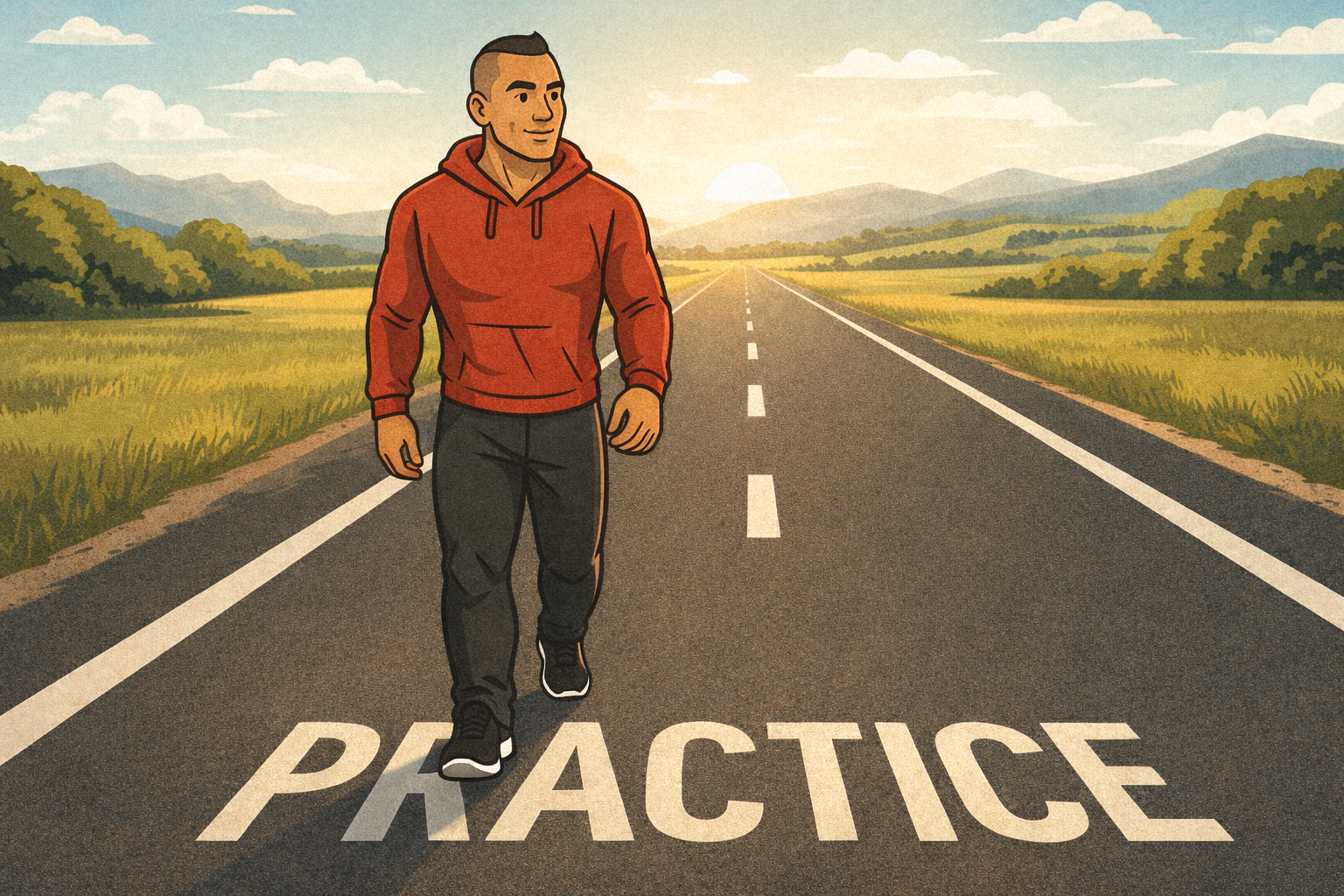
“You don’t rise to the level of your goals. You fall to the level of your systems — and the stories you tell yourself.”
Every January, the same story repeats itself.
New goals.
New promises.
New rules.
New pressure.
“This is the year.”
“I’m going all in.”
“No excuses.”
And for a few weeks, it works.
The workouts are intense.
The nutrition is strict.
The motivation is high.
The scale moves.
The compliments come.
Then life shows up.
Stress.
Fatigue.
Injury.
Work.
Family.
Emotions.
Unexpected loss.
Unexpected hardship.
And suddenly, the resolution collapses — not because the person is weak, but because the approach was never built to last.
I’ve seen this cycle for decades as a coach.
I’ve lived it personally.
And I can tell you this with absolute certainty:
Longevity does not come from resolution energy.
It comes from practice.
Most people believe change requires intensity.
More discipline.
More willpower.
More restriction.
More punishment.
But the human nervous system doesn’t thrive under constant pressure.
It adapts under consistency.
When you treat health like a short-term project, your body responds with short-term results — and long-term backlash.
Did You Know?
Research shows that aggressive behavior change spikes cortisol, which initially boosts fat loss — but increases rebound weight gain, inflammation, and burnout over time.
This is why “all-in” efforts often lead to:
Binge–restrict cycles
Injuries
Mental fatigue
Loss of confidence
Shame spirals
Quitting altogether
Not because people don’t care — but because they are trying to sprint a marathon.
I used to believe intensity was the answer to everything.
Train harder.
Push more.
Ignore the noise.
Stay relentless.
And for a long time, that worked — until life took everything I thought defined me.
I lost:
My business
My home
My marriage
Financial security
My father
Stability
Control
The version of myself I was proud of
And through all of that, one truth became unavoidable:
I could no longer rely on motivation.
I had to rely on practice.
There were days when I didn’t want to train.
Days when nutrition felt impossible.
Days when grief sat heavy.
Days when the future felt unclear.
Days when the old “all-in” version of me would’ve either overtrained or quit.
Practice saved me.
Not perfection.
Not intensity.
Not extremes.
Practice.
Practice is not flashy.
It doesn’t come with fireworks or countdown clocks.
Practice looks like:
Training even when it’s not exciting
Eating well most of the time, not all the time
Walking when you don’t feel like working out
Hydrating when no one is watching
Journaling when emotions feel heavy
Sleeping instead of pushing
Coming back after setbacks
Showing up imperfectly
Practice is boring — and that’s why it works.
Did You Know?
The brain prefers predictability over intensity. Habits rooted in repetition create stronger neural pathways than habits driven by motivation spikes.
Chronic stress accelerates aging.
Inconsistent routines keep the nervous system on edge.
Practice creates safety.
Safety lowers cortisol.
Lower cortisol improves:
Sleep
Hormonal balance
Insulin sensitivity
Immune function
Recovery
Emotional regulation
Longevity begins here.
Extreme dieting and training disrupt metabolism.
Consistent movement and nutrition:
Improve insulin sensitivity
Preserve lean muscle
Support mitochondrial health
Reduce systemic inflammation
Did You Know?
Long-term consistency has a stronger impact on metabolic health than short-term calorie restriction or extreme exercise protocols.
People who live the longest aren’t the most intense.
They’re the most adaptable.
They don’t quit when plans break.
They adjust.
Practice teaches flexibility — the most underrated longevity skill.
Resolutions rely on emotion.
Practice relies on identity.
When you say:
“I’m trying to get healthy” — that’s a resolution.
“I’m someone who practices health” — that’s identity.
Identity-based behaviors stick.
Did You Know?
Studies show that identity-driven habits are up to 3x more likely to be maintained long term than goal-driven behaviors.
This is why:
Walking daily beats extreme cardio
Protein consistency beats perfection
Strength training twice a week beats random intensity
Sleep routines beat supplements
Self-compassion beats self-criticism
Practice looks different across seasons.
Some seasons are strong.
Some are quiet.
Some are heavy.
Some are joyful.
Some are painful.
Longevity doesn’t demand that every season look the same — it demands that you don’t abandon yourself during the hard ones.
I’ve coached people through:
Divorce
Illness
Job loss
Depression
Aging parents
Financial stress
Injuries
The ones who thrive long-term don’t chase perfection — they stay practiced.
Instead of asking:
“What’s my resolution?”
Ask:
What practice can I sustain?
What can I repeat even on hard days?
What version of myself am I practicing becoming?
What habits support me when life gets loud?
Practice is:
Strength training 2–4 days/week
Walking daily
Eating protein at most meals
Sleeping consistently
Writing when overwhelmed
Staying connected to people
Returning after setbacks
Nothing extreme.
Everything meaningful.
The longest-living populations don’t “work out” — they move daily
Consistency predicts longevity more than intensity
Stress resilience matters more than aesthetics
Muscle maintenance matters more than fat loss
Emotional regulation slows biological aging
2026 doesn’t need another resolution.
It needs:
Patience
Compassion
Commitment
Practice
Health is not something you achieve.
It’s something you return to — again and again — especially when life hurts.
If you’ve fallen off before, you’re not broken.
If you’ve quit before you’re human.
If you’ve tried everything you’re tired, not incapable.
Longevity belongs to those who keep practicing.
Not louder.
Not harder.
Not perfect.
Just present.
If you want guidance building sustainable health — not resolution burnout — I can help you create a practice that fits your real life.
📩 amrapfitness@hotmail.com
Harvard School of Public Health
Stanford Behavior Design Lab
Journal of Behavioral Medicine
Blue Zones Research
American College of Sports Medicine
Partner warm up
MB chest pass
MB hip toss
MB rotations
MB sit ups
Wall ball
Skill
Sled drags reverse and sumo
WOD
12 minute ping pong
20m reverse sled drag
20m sumo sled drag