

The Importance of Connection: How Social Interaction Impacts Fitness, Wellness, and Longevity

Introduction

Humans are inherently social creatures. While much focus is placed on exercise, nutrition, and recovery, an often-overlooked factor in health and longevity is social connection. Isolation—whether due to work, lifestyle, or personal circumstances—can have profound negative effects on mental, emotional, and physical health.

Coach Ray Traitz has spent years working with clients who have experienced social isolation, and he actively experiments with strategies to encourage connection while promoting fitness, wellness, and overall life satisfaction. In this blog, we’ll explore why connection matters, the consequences of isolation, and actionable strategies to stay socially engaged for better health and longevity.

The Science Behind Social Interaction and Longevity

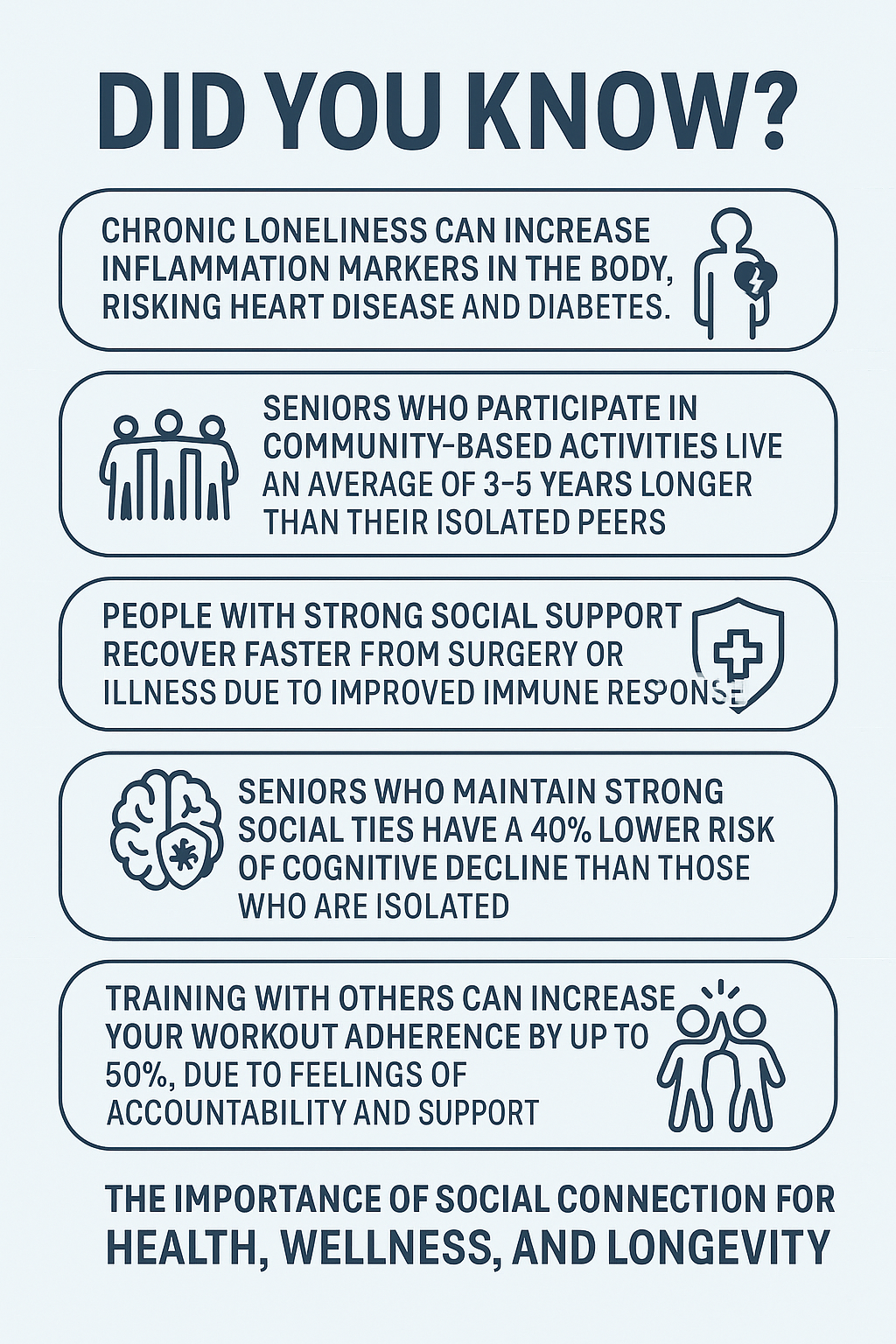
Social isolation has been linked to increased risk of chronic diseases, mental health decline, and decreased life expectancy. Maintaining social ties, on the other hand, positively influences cognitive function, stress resilience, and physical health.

Key Findings:

  • Loneliness has been associated with a 26% increased risk of premature death.

  • Positive social engagement improves cardiovascular health, immune function, and stress management.

  • Social support encourages adherence to fitness and nutrition programs.

Insights from Leading Researchers

Dr. Julianne Holt-Lunstad (Psychology & Longevity)

  • Loneliness as a Risk Factor: Chronic social isolation increases inflammatory markers and can accelerate aging.

  • Social Networks as Health Buffers: Strong social connections can reduce the impact of stress on physical health.

  • Community Engagement: Volunteering and participation in social groups improve mood and long-term well-being.

Dr. Steve Cole (Immunology & Psychosocial Health)

  • Immune Function Benefits: Socially connected individuals show higher immune resilience.

  • Stress Hormone Regulation: Positive social interaction reduces cortisol and other stress-related hormones.

  • Behavioral Motivation: People are more likely to maintain exercise and nutrition routines when socially accountable.

Dr. Laura Carstensen (Longevity & Social Networks)

  • Quality Over Quantity: Deep, meaningful relationships provide more longevity benefits than large social networks.

  • Emotional Health: Engaged individuals have lower rates of depression and anxiety.

  • Cognitive Preservation: Social engagement supports neuroplasticity and slows cognitive decline.

Case Studies on Social Engagement and Longevity

  1. Older Adults and Group Exercise Programs

    • Dr. Holt-Lunstad found that seniors participating in group fitness programs had lower mortality rates and improved mental health compared to isolated peers.

  2. Community Volunteering and Immune Function

    • Dr. Cole’s research showed that adults who volunteered regularly had reduced inflammatory markers and better antibody responses to vaccines.

  3. Cognitive Preservation in Socially Active Seniors

    • Dr. Carstensen’s longitudinal studies demonstrated that seniors with strong social networks had a significantly slower cognitive decline over a 10-year period.
Coach Ray Traitz’s Approach to Social Connection

Coach Ray integrates social interaction into wellness programs by:

  • Small Group Training: Encouraging participants to engage with each other during workouts for accountability and support.

  • Community Challenges: Setting team-based fitness or nutrition challenges to foster camaraderie.

  • Peer Support Systems: Pairing clients to encourage daily communication and motivation.

By prioritizing connection, Ray ensures clients experience not only physical improvements but also enhanced mental and emotional well-being.

Why Work with Coach Ray Traitz?

If you want to enhance your fitness, nutrition, and longevity while staying socially connected, Coach Ray Traitz is the guide to help you achieve these goals. His programs are designed to foster meaningful relationships, accountability, and holistic well-being.

For personalized coaching, contact Coach Ray Traitz at amrapfitness@hotmail.com.

Resources

  1. Holt-Lunstad, J., Smith, T. B., & Layton, J. B. (2010). "Social relationships and mortality risk: A meta-analytic review." PLoS Medicine.

  2. Cole, S. W. (2014). "Social regulation of human gene expression: Mechanisms and implications for health." Psychosomatic Medicine.

  3. Carstensen, L. L., & Mikels, J. A. (2005). "At the intersection of emotion and cognition: Aging and the positivity effect." Current Directions in Psychological Science.

Ray Traitz
10/4 🇺🇸 HERO SATURDAY 🇺🇸

Servais

For time:
Run 1.5 miles
Then, 8 rounds of:
19 pull-ups
19 push-ups
19 burpees
Then,
400-meter sandbag carry (heavy)
1-mile farmers carry with 45-lb. dumbbells

U.S. Air Force Senior Airman Adam Servais, of Onalaska, Wisconsin, died Aug. 19, 2006, in Uruzgan Province, Afghanistan, when his vehicle came under hostile fire. The 23-year-old was assigned to the 23rd Special Tactics Squadron, Hurlburt Field, Florida. Servais is survived by his parents, Peter and Susan; and sister, Laura.

Ray Traitz
Friday 10/3

Warm Up 

Sampson

Dips

Pull ups

Sit ups

OHS

WOD

Mary or Cindy

20 minute AMRAP

Mary- 5 HSPU, 10 pistols, 15 pull ups

Cindy- 5 pull-up, 10 push-ups, 15 squats

Ray Traitz
Everyday Strategies to Feel Better in Your Body and Mind

Some days feel off before they even begin. You wake up groggy, shuffle into your morning, and something’s missing — clarity, energy, maybe even purpose. But well-being isn’t something you have to chase with intensity. It builds slowly, stacking small behaviors, moments, and patterns that reinforce the life you want to live. Instead of overhauling everything at once, focus on making a few intentional shifts. The following strategies will help you create rhythm, feel more grounded, and show up better — every single day.

Starting a Sustainable Fitness Routine

Fitness isn’t a punishment — it’s a recalibration tool. Even ten minutes of movement can shift your entire chemistry, especially when done with consistency. If you’re overwhelmed by options, start with one thing: a walk, a bodyweight circuit, or a few yoga poses before breakfast. The key is frequency, not intensity. If you want accountability, working with a personal trainer from AMRAP Fitness can help you establish a rhythm that fits your lifestyle. The goal isn’t athleticism — it’s aliveness.

Managing Daily Stress Responses

Stress doesn’t vanish just because you meditate or take a walk — but the way you respond to it can change everything. Instead of trying to suppress uncomfortable emotions, build your awareness of what’s happening internally when stress hits. Whether it’s a tight deadline, a passive-aggressive email, or an unexpected bill, your ability to pause and name the friction gives you leverage. Try checking in with your body before reacting: are your shoulders clenched, your breathing shallow, your fists tight? That data helps you notice your stress response early, when it’s more manageable. This isn’t about “reducing stress” — it’s about regaining agency.

Exploring Career Change Through Education

If you’re stuck in a career that feels empty, you’re not alone — and you’re not trapped. Thousands of people pivot into more meaningful fields every year, even while juggling work or family responsibilities. Online degree programs make it easy to earn your degree while still working full-time or tending to family obligations. Specifically, by earning a psychology degree, you can study the cognitive and affective processes that drive human behavior so you can support those in need of help — read this for more info. Career change doesn’t have to be reckless — it can be thoughtful, gradual, and transformative.

Establishing Time Management Habits

If your days feel scrambled, your well-being will too. Poor time management leaks into your sleep, your relationships, even your ability to eat or move with intention. Building structure isn’t about being rigid — it’s about protecting energy for what matters. Audit your days for low-value friction: constant notifications, repetitive decisions, unplanned tasks. The more you reduce those drains, the more you recover a sense of forward motion. Time structure is a mental health strategy, not a productivity hack.

Improving Mood Through Nutrition

What you eat affects how you think, move, and feel — sometimes more than you realize. Highly processed, sugar-loaded meals spike and crash your energy, leaving your focus shredded. On the flip side, meals that combine protein, fiber, and fat help your body stabilize and your mind stay sharp. You don’t need to overhaul your diet; just start paying attention to how different foods make you feel 90 minutes later. Nutrition isn’t about “clean eating” — it’s about emotional regulation, energy flow, and long-term focus. Your brain’s biochemistry runs on what you feed it.

Using Journaling for Mental Clarity

Sometimes, you don’t need a solution — you need a place to put your thoughts. Journaling isn’t about perfect prose or introspective wisdom; it’s about unloading noise from your mind. When things get tangled internally, language helps you name the tension and loosen its grip. Set a timer for five minutes, write without editing, and stop when it buzzes. Don’t aim for insight — aim for space. You’re not writing to explain your life to others, you’re writing to make it livable for yourself.

Setting Boundaries Around Screen Use

It’s not just about doomscrolling. Every hour you spend on screens — especially late at night — shapes your sleep, mood, posture, and mental clarity. And no, multitasking doesn’t cancel the harm; it just diffuses your attention further. Try one screenless hour in the morning and one in the evening. Use that time for transitions: stretch, clean, eat without distraction, or go outside. Boundaries don’t have to be harsh — they just have to be consistent enough to change the feel of your day.

Prioritizing Consistent Sleep Patterns

Your sleep hygiene shapes how well your brain repairs itself overnight. It’s not just the number of hours — it’s when you fall asleep, how consistently you do it, and how you wind down beforehand. A stable nighttime routine cues your nervous system to shut down gently instead of crashing. Even something simple — dimming lights, avoiding email after 9 p.m., or taking a hot shower — can make a noticeable difference. Don’t save rest for when you’re burned out; bake it into your daily rhythm. Sleep is when your system does behind-the-scenes maintenance — skip it, and the day gets harder.

Well-being isn’t a checklist — it’s a loop. You eat, move, rest, think, and interact every day, and each of those inputs shifts how you feel and perform. The good news is that you don’t need perfection to feel better — just consistency and self-awareness. Start small. Pick one of these strategies and try it for a week. Notice what changes — then build from there. You don’t have to overhaul your life to change your day.

Elevate your fitness with AMRAP Fitness, where personalized training, nutrition, and accountability come together to help you achieve your health goals, whether you’re a beginner or an elite athlete!

Ray Traitz