
Muscle as Medicine: Sarcopenia, Strength, and the Anti-Fragile Body After 40
“Aging is not lost youth—it’s gained responsibility.”
— A reminder I come back to when the goal shifts from looking fit to staying capable.
Opening Device: The Front Squat Test You Didn’t Know You Were Taking
At some point, life stops asking you how much you can lift on your best day…
and starts asking what you can do on your worst week.
You sleep four hours for three nights straight.
Your schedule collapses.
Your stress appetite shows up.
Your joints feel “older” than your driver’s license says.
And then the real question appears:
Can your body still produce force, protect your joints, stabilize your spine, and recover—without drama?
That’s why this entry is about muscle as medicine. Not muscle for ego.
Muscle for buffer, independence, stability, metabolic control, and longevity.
If Entry #2 was about metabolic reserve (your ability to absorb stress and return to baseline), Entry #3 is about the asset that builds a huge portion of that reserve:
Skeletal muscle.
What Sarcopenia Really Is (And Why It’s Not Just “Getting Older”)
Sarcopenia is often described as “age-related muscle loss,” but that phrasing makes it sound passive—like weather.
Modern clinical consensus frames sarcopenia more like muscle failure, and importantly:
Low muscle strength is treated as the primary signal—not aesthetics, not scale weight.
That matters because strength is not just “gym performance.” Strength is a proxy for:
tissue quality
nervous system output
coordination and stability
your ability to generate force quickly when it counts (catching a trip, carrying groceries, getting up off the floor)
In other words: strength is survival-capacity in disguise.
Did You Know?
The European consensus (EWGSOP2) emphasizes muscle strength first in identifying sarcopenia—because strength tracks function more reliably than muscle mass alone.
Why Muscle Is “Metabolic” (Even When You’re Sitting Still)
Most people think metabolism is about fat loss.
In reality, your muscle tissue plays a major role in:
blood sugar management
inflammation regulation
insulin sensitivity
how well you tolerate stress without spiraling
Muscle is one of the largest “storage and processing sites” for glucose. When you lose muscle, it’s not just a physique change—your metabolic system loses capacity.
So when we say muscle is medicine, we’re talking about medicine that improves:
how stable you feel
how stable your energy is
how stable your appetite behaves
how stable your recovery becomes
That’s metabolic reserve, expressed physically.
The Data Doesn’t Whisper: Strength Training Is Linked to Lower Mortality Risk
This isn’t influencer talk. Large analyses keep landing on the same practical conclusion:
Muscle-strengthening activity is associated with lower risk of all-cause mortality and major diseases, with many findings showing benefits around 30–60 minutes per week (a “dose” that doesn’t require living in the gym).
Dose–response analyses suggest a nonlinear relationship—meaning you don’t need extreme volumes to get meaningful benefit.
Recent scientific reviews also report that adults who do resistance training show lower all-cause mortality risk compared with none.
Did You Know?
Several meta-analyses show a “sweet spot” effect: some strength training is dramatically better than none, and the biggest returns often appear at modest weekly volume.
The Coaching Truth: Most People Don’t Need “More Work”—They Need a Better Target
Here’s where I’ll keep it real (without turning this into autobiography):
Most adults I coach aren’t failing because they’re lazy.
They’re failing because they’re overwhelmed—and they’re chasing the wrong scoreboard.
They chase:
soreness as proof
intensity as identity
“sweat or it doesn’t count”
all-or-nothing programs
But after 40, the real win is anti-fragility:
You can train hard sometimes—without needing to train hard all the time.
You can progress—without breaking your sleep or your joints.
You can stay athletic—without living on the edge of burnout.
That’s longevity training.
Why Functional Fitness Still Fits (If You Train It Like an Adult)
Functional fitness (CrossFit-style training) can absolutely support longevity—when it’s programmed to build capacity, not chaos.
Here’s the pivot:
Longevity-Focused Functional Fitness Priorities
Strength base first (controlled reps, clean positions)
Aerobic base second (Zone 2 capacity to recover and stay resilient)
Power/conditioning as seasoning, not the main course
Skill + mechanics stay sacred (your joints are not disposable)
Did You Know?
Balanced movement training (aerobic + muscle-strengthening) is consistently associated with better mortality outcomes than doing neither—and often better than treating training as only one category.
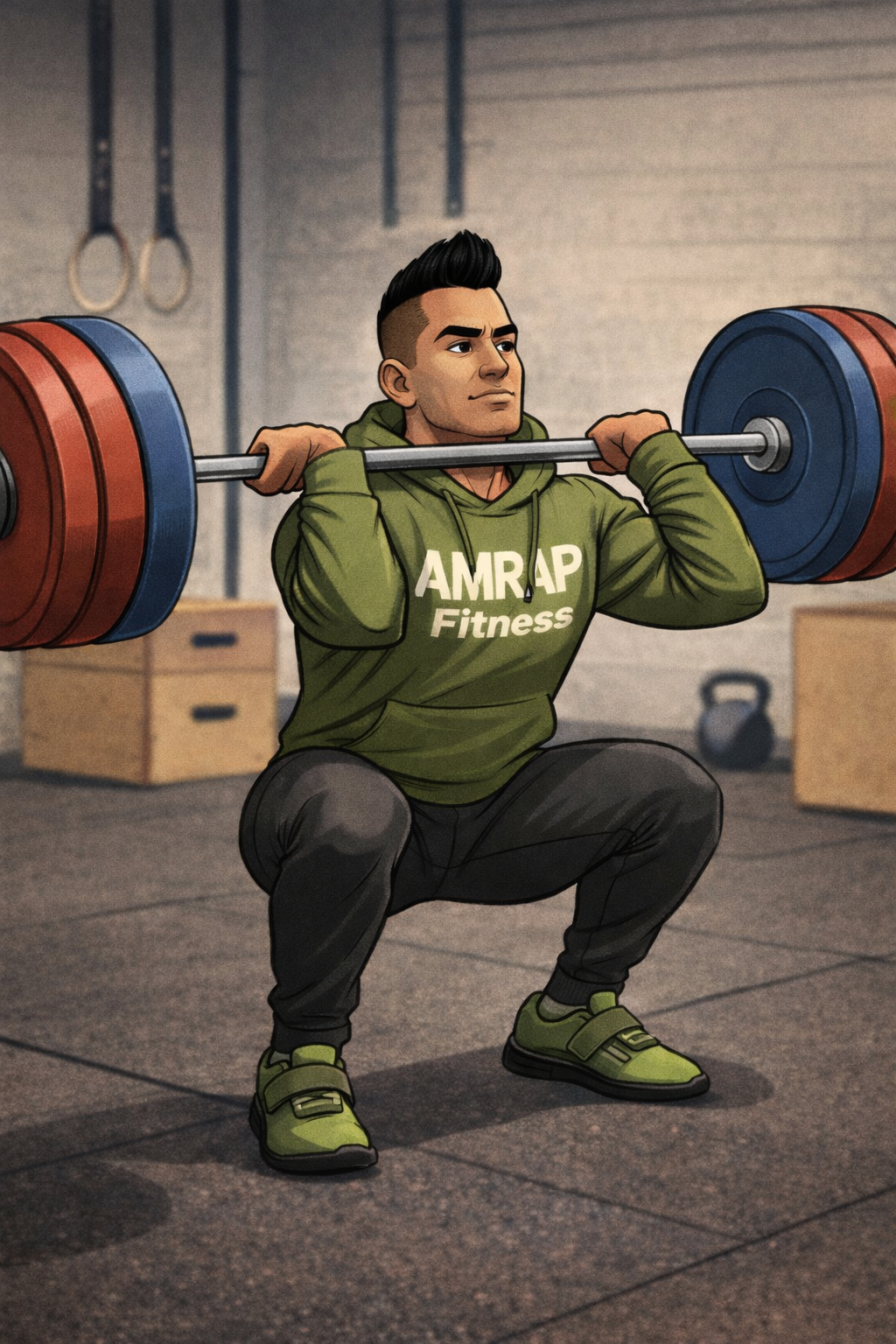
The Front Squat Principle: “Strong Positions Create Strong Lives”
Let’s talk front squats—not as a flex, but as a symbol.
A good front squat requires:
upright torso strength
trunk stiffness without rigidity
ankle/hip mobility that stays usable
breathing under load
calm in discomfort
In real life, that becomes:
picking something up safely
bracing your spine when you slip
carrying awkward loads
staying confident in your body
So yes—front squats are a longevity movement when trained intelligently.
Coaching Application: Build Muscle Like You’re Building a Retirement Account
Step 1: Choose a “Minimum Effective Dose” Strength Plan (2–4 days/week)
You don’t need perfection. You need repeatability.
Non-negotiable movement patterns:
squat (front squat variation)
hinge (RDL / deadlift variation)
push (press / push-up)
pull (row / pull-up progression)
carry (farmer carry / suitcase carry)
trunk (anti-rotation, anti-extension)
Programming rules that keep adults improving:
progress slowly (add 2.5–5 lbs, or 1–2 reps)
keep most sets 1–3 reps in reserve (not failure every day)
treat form like a contract with your future self
Did You Know?
Sarcopenia frameworks emphasize function—strength and performance—because those elements map directly to real-world independence.
Step 2: Use Conditioning to Support Recovery, Not Compete With It
If you’re always crushed, you’ll eventually stop.
The longevity-friendly conditioning hierarchy:
Zone 2 (conversational pace, 20–45 min)
Short intervals (carefully dosed, not daily)
Metcons (sparingly, programmed, not impulsive)
This protects your ability to lift, sleep, and recover—which protects your ability to stay consistent.
Step 3: Protein Is the Brick Supply (But Context Matters)
Protein is one of the simplest levers for preserving muscle with age.
Many expert groups recommend higher protein intake for older adults—often in ranges like ~1.0–1.2 g/kg/day, and more (e.g., ~1.2–1.5 g/kg/day) for active people or during stress/illness—with important exceptions, such as advanced kidney disease where guidance should be individualized.
Practical coaching approach:
protein at every meal
prioritize breakfast protein (most people under-eat it early)
keep “default options” available (Greek yogurt, eggs, lean meats, shakes, beans + rice combos)
Did You Know?
Protein guidance for older adults often increases during illness, recovery, or high training demand—because the goal is maintaining function, not just hitting a macro target.
Step 4: Train Your Nervous System to Stay Powerful (Without Living in Pain)
Power matters. Fast force production protects you when you trip, slip, or need to move quickly.
But power for longevity doesn’t mean reckless maxing.
Low-risk power options:
medicine ball throws
kettlebell swings (when hinge mechanics are solid)
low-volume Olympic lift technique (submax, crisp)
jumps only if joints tolerate them (and you land well)
The rule: power is earned, not forced.
A Simple Week Template (Longevity-Driven, Functional-Fitness Friendly)
Day 1 – Strength (Squat focus)
Front squat (moderate, crisp reps)
Split squat
Row + carry
Trunk work
Day 2 – Zone 2
30–45 minutes conversational pace (bike, incline walk, row)
Day 3 – Strength (Hinge + press)
RDL or deadlift variation
Overhead press
Pull + carry
Trunk work
Day 4 – Optional short conditioning
8–12 minutes intervals (not a death march)
Or technique + mobility if life is heavy
Day 5 – Strength (Full body + athletic)
Front squat light technique OR clean pulls
Push-ups/dips progression
Pull-ups progression
Loaded carries
Weekend – Movement + recovery
long walk, mobility, light sled, play, breathe
This is what “anti-fragile” looks like: enough stress to adapt, not so much you collapse.
25% Relatable Coaching Insight (Why This Matters When Life Is Not Kind)
I’ve coached through seasons where people weren’t just “busy.”
They were dealing with real pressure—grief, financial strain, broken sleep, identity changes, relationship stress.
In those seasons, the goal is not “get shredded.”
The goal is don’t break.
Muscle becomes a form of protection:
it keeps your routine from evaporating
it stabilizes your joints when stress tightens everything
it gives you a physical identity that doesn’t depend on perfect circumstances
Muscle is something life can’t easily take from you—if you train it with respect.
Closing: The Goal Is Not a Younger Body—It’s a More Capable Future
Your future self doesn’t need you to be extreme.
Your future self needs you to be consistent.
Build muscle like it matters—because it does.
Not as vanity. As capability.
Not as punishment. As preparation.
That’s not gym culture. That’s longevity.
Resources
EWGSOP2 (Cruz-Jentoft et al.). Sarcopenia revised European consensus: low strength as primary parameter.
Momma et al. Muscle-strengthening activity and lower risk of mortality/disease (systematic review/meta-analysis).
Shailendra et al. Resistance training dose–response and mortality risk.
Paluch et al. Resistance exercise training and mortality risk overview.
PROT-AGE Study Group (Bauer et al.). Protein recommendations for older adults (with kidney disease exception).
López-Bueno et al. Combined aerobic + muscle strengthening associations with mortality.